RddBull.com will fully be up and running soon
Energy Management Techniques — A Practical System for Consistent High Performance
Introduction
Most people think productivity is about time. But in reality, time is useless without the energy to use it wisely. Energy Management Techniques are the foundation of sustainable productivity, resilience, creativity, and long-term high performance. Instead of squeezing more into your schedule, you learn to work with your natural biological rhythms, cognitive cycles, emotional bandwidth, and environmental triggers.
In earlier articles—such as The Daily Energy Curve and The Energy Quadrant System—we explored what shapes your energy. This article brings everything together and turns it into a practical, methodical, step-by-step system.
Section 1 — Why Energy Management Techniques Beat Time Management
Time management tries to fit tasks into a calendar.
Energy management optimizes your ability to execute those tasks well.
Key reasons energy management techniques outperform time management:
- Time is fixed; energy fluctuates hourly.
- Productivity depends on biological and mental states, not the clock.
- Better energy → fewer errors, deeper work, and higher creativity.
- Sustainable results require managing capacity, not cramming more tasks.
This shift reflects what athletes have long known: peak output depends on cycles of exertion and recovery, not constant effort.

Section 2 — The Four Domains of Energy You Must Manage
Effective Energy Management Techniques work across four interconnected domains:
2a. Physical Energy
Your body sets the foundation for cognitive output.
You cannot outperform poor sleep, inconsistent nutrition, dehydration, or chronic physical tension.
Key drivers:
- Sleep cycles
- Blood sugar stability
- Movement frequency
- Hydration
- Breathing patterns
See the Energy Quadrant System for a deeper breakdown.
2b. Cognitive Energy
Your brain’s ability to focus depends on its fuel levels, mental clarity, and cognitive load.
Cognitive drains include:
- Task switching
- Heavy decision-making
- Notifications
- Long periods without rest
- Lack of novelty or challenge
This is why deep-work blocks outperform fragmented task lists.
2c. Emotional Energy
Your emotions determine your mental bandwidth and resilience.
Common emotional drains:
- Unresolved stress
- Negative internal narratives
- Pressure without recovery
- Poor emotional boundaries
Conversely, positive emotional states dramatically increase creativity, speed, and problem-solving.
2d. Environmental Energy
Your surroundings influence your cognitive performance more than you realize.
Environmental triggers include:
- Noise
- Lighting
- Screen layout
- Digital clutter
- Workspace organization
- Temperature
Optimized environments reduce friction and increase your ability to enter deep focus.
Section 3 — The Energy Management Pyramid
Here is a practical model you can apply immediately. Start at the base; if you skip levels, the upper layers fail.
3a. Layer 1: Stabilize Biological Inputs
Before any advanced techniques, stabilize:
- Sleep (consistent cycle)
- Movement (light hourly movement + strength work)
- Hydration (2–3L/day depending on body size)
- Nutrition timing
These are the non-negotiable prerequisites for effective energy management.
3b. Layer 2: Create Cognitive Boundaries
This layer eliminates drains to preserve mental clarity.
Core methods:
- Focus sprints
- Notification control
- Task batching
- Decision offloading
- Limiting multitasking
- Prioritizing high-cognitive-load work early in the day
See Digital Focus — Mastering Attention in a Distracted World for more.
3c. Layer 3: Emotional Regulation Systems
Your emotional state determines your capacity to persist and solve problems.
Proven Energy Management Techniques here include:
- Breath resets
- Mindfulness micro-moments
- Journaling for clarity
- Premortem + postmortem reflections
- Clear personal boundaries
Use these to maintain emotional bandwidth throughout the day.
3d. Layer 4: Environment Engineering
This is where you architect surroundings that support peak performance rather than hinder it.
Examples:
- Clean digital desktop
- Simple workspace with minimal friction
- Temperature at 20–22°C
- Using noise profiles that match task type (e.g., brown noise for deep work)
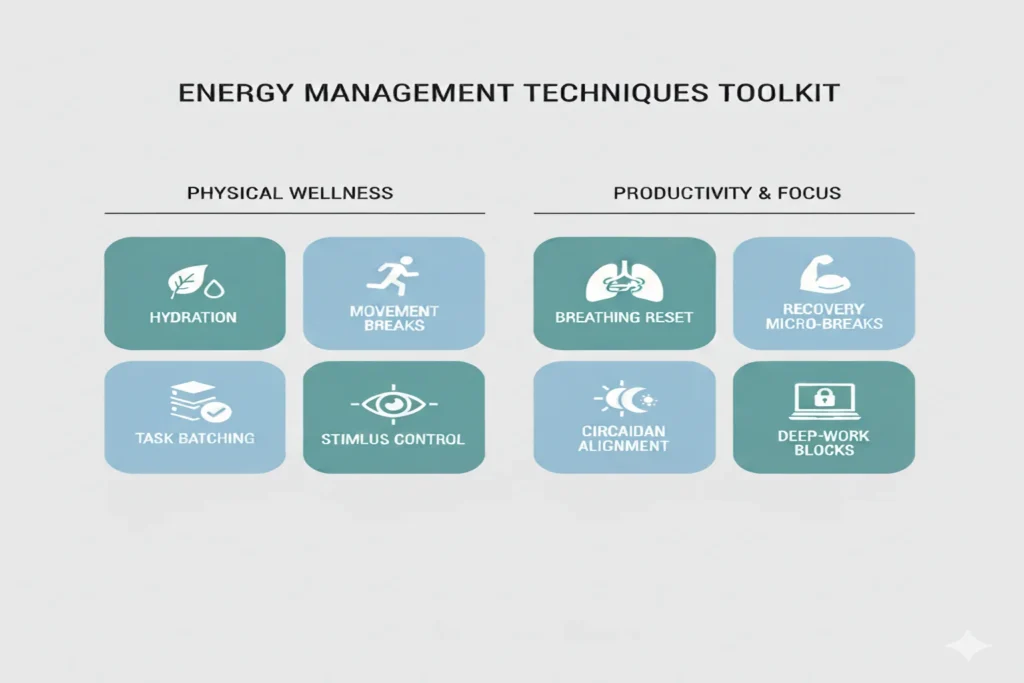
Section 4 — The Essential Energy Management Techniques Toolkit
Below are eight of the most powerful techniques used by entrepreneurs, researchers, executives, and high-performing creators.
4a. Technique #1: The 90/20 or 50/10 Focus Rhythm
Work for a defined block, rest briefly.
This mimics cognitive ultradian rhythms.
4b. Technique #2: Strategic Task Placement
Place heavy thinking tasks in the morning peak;
use dips for administrative or mechanical tasks.
This aligns with your Daily Energy Curve.
4c. Technique #3: “Energy Matching” Instead of Scheduling
Instead of scheduling tasks by time, assign tasks to the energy state required.
Energy states:
- High → analysis, deep work
- Medium → meetings, collaboration
- Low → chores, admin, planning
4d. Technique #4: State Shifting (Reset Rituals)
These are 1–3 minute resets that switch you into a different energy mode.
Examples:
- Standing + stretching
- Box breathing
- Cold water splash
- Quick journaling
- Changing environment
4e. Technique #5: Decision Reduction
Every unnecessary decision drains energy.
Reduce it by:
- Pre-setting meals
- Using templates
- Automating workflows
- Reducing daily app clutter
4f. Technique #6: The “No Multi-Device Rule”
Even one additional device splits attention.
Pick ONE device per work session.
4g. Technique #7: Energy Anchoring
Use physical or environmental anchors that tell your brain “deep work starts now.”
Examples:
- A specific candle or diffuser
- A single desk lamp
- A specific playlist
- A dedicated chair
4h. Technique #8: The Afternoon Reboot Protocol
Instead of dragging through the midday dip, reboot your system:
Protocol:
- Light movement
- Hydration + salt
- Protein + fruit
- 2-minute breath reset
- 10 minutes of planning or reorganizing
This creates a second wind for the afternoon.
Section 5 — Building Your Energy Management System
Use this simple weekly system to implement everything you’ve learned.
5a. Step 1: Map Your Weekly Energy Patterns
Track:
- Sleep
- Energy peaks
- Energy dips
- Emotional triggers
- Productive hours
5b. Step 2: Install Your Daily Energy Rituals
Create a consistent structure:
- Morning activation
- Midday recovery
- Afternoon reboot
- Evening shutdown
Each ritual reinforces your system.
5c. Step 3: Review, Refine, Replace
Each week, evaluate:
- What drained the most energy
- What created the highest output
- What environmental changes helped the most
- Which techniques worked reliably
Then adjust your system.
Image 3 Placeholder — placed in Section 5
Image Title: Weekly Energy Review Framework
Filename: weekly-energy-review.webp
Alt Text: Diagram showing a structured weekly energy review system.
Caption: A weekly review helps refine your personal energy strategy.
Description: A clean flat-style framework illustrating weekly review steps for energy optimization.
Recommended Size: 1600 × 900
Placement: After Section 5
Conclusion
You cannot control time—but you can control your energy inputs, boundaries, and systems. Mastering Energy Management Techniques shifts you from reactive productivity to intentional, sustainable high performance.
If you’re ready to advance further, continue with:
